
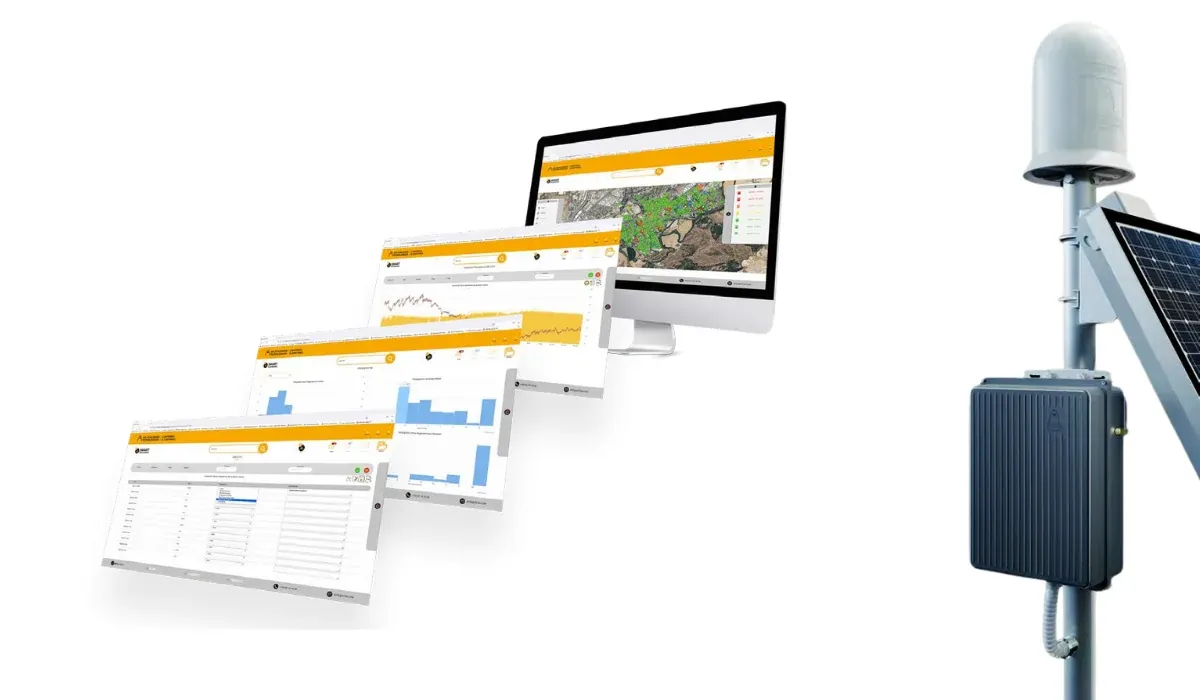
Early warning complements a structure's lightning protection system. It adds an operational risk prevention layer.
How does ATSTORM® work?
IEC 62793:2020 describes the electrostatic field as an early detectable sign of a storm. According to the manufacturer, ATSTORM® measures that field continuously and can detect storm development before the first lightning discharge. It can therefore respond to storms forming over a site as well as storms approaching from a distance.
- Collect data: On-site sensors monitor electrostatic and electromagnetic fields. The electromagnetic sensor extends detection to active storms tens of kilometres away.
- Assess conditions: Data is sent to the manufacturer's AT-CLOUD platform, where specialist algorithms assess storm formation or approach.
- Warn and clear: Staged alerts are intended to provide up to tens of minutes to start precautions. A measured "no risk" notification supports decisions about resuming work, rather than relying only on a fixed waiting period.
Alerts and automation
- Mobile app, email, instant messages and the ATSTORM-Connect web portal
- SCADA integration
- Remote relay module for sirens, warning lights or auxiliary equipment
- Staged warning levels for staged site precautions
- Alert history, electrostatic-field trends, PDF reports and CSV exports
Technical data (AT-550)
| Property | Manufacturer data |
|---|---|
| Electrostatic sensor | −32 to +32 kV/m, 1 V/m resolution, 20 km detection; fully electronic, no moving parts |
| Electromagnetic sensor | 40 km detection |
| Power | 20 W solar panel and 10 Ah battery (seven-day autonomy); 110–250 VAC backup |
| Communications | Mobile VPN (2G/3G/LTE-M/NB-IoT), Ethernet, optional satellite |
| Enclosure and environment | IP66; −40 °C to +85 °C |
| Standards (manufacturer statement) | EMC IEC 61000-6-4 and electrical safety IEC 61010-1 compliant; FCC Part 15 / ICES-003 certified |
The sensor count and locations are established through site-specific analysis. The manufacturer states that installation does not require the customer's power or communications infrastructure.
Who is it for?
Applications include oil, gas and chemical operations; mines, shipyards and power sites; airports and ports; outdoor events and public areas; and facilities with dense electronic infrastructure. Typical precautions include moving personnel to safety, pausing outdoor work, delaying hazardous operations and activating auxiliary systems.
Early warning compared with lightning protection
| Early warning (ATSTORM®) | Lightning protection / prevention | |
|---|---|---|
| Main focus | People and operations | Structures and equipment |
| When it acts | As a storm forms or approaches | Continuously / during a discharge |
| Output | Staged alerts and operational measures | Reduced strike risk or a safe current path to earth |
The approaches complement each other. In ASIVA's layered design, early warning can sit alongside the PDCE lightning prevention system.
Frequently asked questions
Does an early warning system replace an air terminal?
No. It does not protect a structure from a strike; it provides time to protect people and operations.
How much warning time does it give?
The manufacturer aims to provide tens of minutes for precautions. Actual lead time depends on the storm's development and the site's location.
Can it trigger unnecessary alarms?
Thresholds are configured for site conditions. The system evaluates local atmospheric measurements to reduce unnecessary alerts, although alerts still require an operational response plan.