
Why monitor between inspections?
A periodic test describes conditions on the day it is performed. Monitoring gives maintenance teams data about what happens between tests:
- G-Check and EMS can monitor continuously. G-Check makes loop deterioration visible; EMS detects earth-pit resistance threshold breaches. Alarms depend on device configuration.
- Trends can help teams investigate a change before a fault interrupts operations.
- Measurement records support reporting and reduce manual checking effort.
Monitoring complements periodic measurements and inspections; it does not replace those required by a project or applicable rules.
ASIVA's earthing monitoring methods
There is no single method for every installation. The choice depends on the earthing arrangement and number of points.
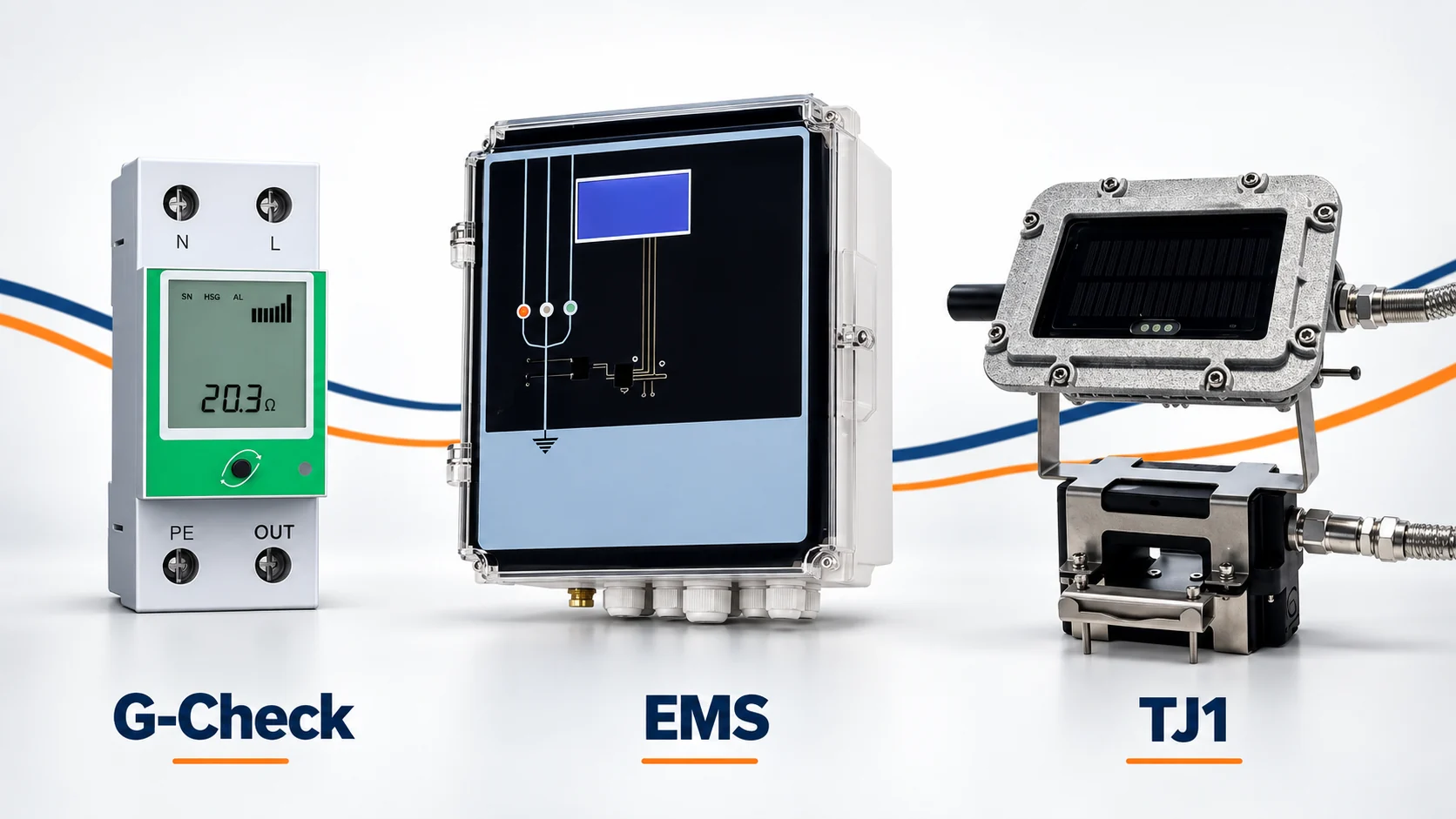
G-Check — panel-mounted loop resistance monitoring
Mersen (Cirprotec brand), Spain
G-Check applies a voltage pulse to the earthing conductor and measures the return current through neutral to calculate loop resistance. For TT and TN-S arrangements, it monitors the impedance of the leakage path relevant to indirect-contact safety.
- Measurement range from milliohms up to 500 Ω
- Continuous monitoring with an alarm output when a user-set limit is exceeded
- Red fault indicator and one-button configuration
- Applications include telecom towers, buildings and medium/low voltage transformer outlets
See the G-Check brochure for model-specific data.
EMS — intelligent earth electrode measurement
RFBytes, India
EMS measures earth electrode resistance using the three-pole fall-of-potential method and brings that measurement into continuous monitoring.
- Separate measurement of up to three earth pits, 0–30 Ω per pit
- Configurable thresholds and time settings
- Two dry contacts (5 A / 250 VAC) for local alarm or trip arrangements
- RS485 connectivity for SCADA and control systems
- LCD and healthy/fault LEDs in an industrial panel assembly
Find the EMS brochure in the document centre.
TJ1 — multi-point earthing resistance monitoring
TAIHANG, China
TJ1 uses a split-core sensor around a down conductor to measure loop resistance periodically without disconnecting the conductor. TJ1-A sends data over 4G; TJ1-B uses RS485. Multiple points can be viewed in the same software.
Find the TJ1 brochure in the document centre.
Comparison
| G-Check | EMS | TJ1 | |
|---|---|---|---|
| Measurement | Loop resistance by voltage pulse | Three-pole fall-of-potential electrode resistance | Split-core loop resistance |
| Coverage | One loop per panel | Up to three earth pits | Multiple networked points |
| Alerts and data | Continuous monitoring and alarm output | Continuous monitoring, two dry contacts and RS485/SCADA | Measurement at configurable intervals; 4G (TJ1-A) or RS485 (TJ1-B) |
The methods measure different things. G-Check and TJ1 monitor loop resistance in different settings, while EMS measures electrode resistance.
Applications
Data centres, solar and wind power facilities, substations, telecom towers, petrochemical sites, industrial plants and other critical infrastructure where earthing continuity needs to be tracked.
Frequently asked questions
Does monitoring replace periodic earthing tests?
No. It reveals changes between scheduled tests. Required periodic measurements and inspections still take place.
Which system should I choose?
The earthing arrangement, point count and remote access needs decide. G-Check suits panel-based loop monitoring; EMS measures electrode resistance and connects to SCADA; TJ1 periodically monitors many networked points. A site survey determines the selection.
How does this relate to lightning protection?
Lightning current ultimately reaches earth through the earthing system. If its condition deteriorates, the external lightning protection system may not perform as designed.
A starting point for your role
Purchasing team
Where can I find the current product brochures?
The document centre has separate entries for G-Check, EMS and TJ1. Follow the relevant entry to the current document.
What existing information can I bring to a first discussion?
You can share the earthing arrangement, number of monitoring points and remote access needs through the contact page. These topics also appear in “Which system should I choose?” above.
Project team
Where can I compare the methods in one place?
The “Comparison” section above presents the existing method descriptions side by side. You can also open the product documents from the document centre.
How can I reach the related risk assessment service?
The Lightning Risk Assessment page describes the service approach. The Lightning Risk Calculator is another starting point for a preliminary assessment with the information you already have.
Operations and maintenance team
Where is the relationship with periodic testing explained?
The question “Does monitoring replace periodic earthing tests?” above covers this relationship. The Continuous Energy Infrastructure Monitoring page provides related reading.
How can we discuss our existing monitoring needs?
Share the points you monitor and your remote access needs through the engineering contact page. The brochure links above lead back to the existing product documents.